Prepare for the Overlords!

Facebook Badge

Wednesday, April 23, 2008


A new prosthetic hand is being tested at the Orthopedic University Hospital in Heidelberg / Grip function almost like a natural hand

It can hold a credit card, use a keyboard with the index finger, and lift a bag weighing up to 20 kg - the world's first commercially available pros-thetic hand that can move each finger separately and has an astounding range of grip configurations. For the first time worldwide a patient at the Orthopedic University Hospital in Heidelberg has tested both the "i-LIMB" hand in comparison with another innovative prosthesis, the so called "Flu-idhand". Eighteen-year-old Sören Wolf, who was born with only one hand, is enthusiastic about its capabilities.

The new prosthetic hand developed and distributed by the Scottish com-pany "Touch Bionics" certainly has advantages over previous models. For example, a comparable standard product from another manufacturer al-lows only a pinch grip using thumb, index, and middle finger, and not a grip using all five fingers. This does not allow a full-wrap grip of an object.

Myoelectric signals from the stump of the arm control the prosthesis

Prototype of the 'Fluidhand' of the Research Center in Karlsruhe. - Source: Orthopedic University Hospital in Heidelberg
Complex electronics and five motors contained in the fingers enable every digit of the i-LIMB to be powered individually. A passive positioning of the thumb enables various grip configurations to be activated. The myoelectric signals from the stump control the prosthetic hand; muscle signals are picked up by electrodes on the skin and transferred to the control electron-ics in the prosthetic hand. Batteries provide the necessary power.

The "Fluidhand" from Karlsruhe, thus far developed only as a prototype that is also being tested in the Orthopedic University Hospital in Heidel-berg, is based on a somewhat different principle. Unlike its predecessors, the new hand can close around objects, even those with irregular surfaces. A large contact surface and soft, passive form elements greatly reduce the gripping power required to hold onto such an object. The hand also feels softer, more elastic, and more natural than conventional hard prosthetic devices.

"Fluidhand" prosthetic device offers better finishing and better grip function

The flexible drives are located directly in the movable finger joints and operate on the biological principle of the spider leg - to flex the joints, elastic chambers are pumped up by miniature hydraulics. In this way, in-dex finger, middle finger and thumb can be moved independently. The prosthetic hand gives the stump feedback, enabling the amputee to sense the strength of the grip.

Thus far, Sören has been the only patient in Heidelberg who has tested both models. "This experience is very important for us," says Simon Steffen, Director of the Department of Upper Extremities at the Orthopedic University Hospital in Heidelberg. The two new models were the best of those tested, with a slight advantage for Fluidhand because of its better finishing, the programmed grip configurations, power feedback, and the more easily adjustable controls. However, this prosthetic device is not in serial production. "First the developers have to find a company to produce it," says Alfons Fuchs, Director of Orthopedics Engineering at the Orthope-dic University Hospital in Heidelberg, as the costs of manufacturing it are comparatively high. However it is possible to produce an individual model. Thus far, only one patient in the world has received a Fluidhand for every-day use. A second patient will soon be fitted with this innovative prosthe-sis in Heidelberg.

Note: This story has been adapted from a news release issued by the Universitäts

Monday, April 14, 2008

Computerworld > Open source 3D printer copies itself


Computerworld > Open source 3D printer copies itself: "Based in the Waitakeres, in West Auckland, software developer and artist Vik Olliver is part of a team developing an open-source, self-copying 3D printer. The RepRap (Replicating Rapid-prototyper) printer can replicate and update itself. It can print its own parts, including updates, says Olliver, who is one of the core members of the RepRap team.
The 3D printer works by building components up in layers of plastic, mainly polylactic acid (PLA), which is a bio-degradable polymer made from lactic acid. The technology already exists, but commercial machines are very expensive. They also can’t copy themselves, and they can’t be manipulated by users, says Olliver.

RepRap has a different idea. The team, which is spread over New Zealand, the UK and the US, develops and gives away the designs for its much cheaper machine, which also has self-copying capabilities. It wants to make the machine available to anybody — including small communities in the developing world, as well as people in the developed world, says Olliver.

Accordingly, the RepRap machine is distributed, at no cost, under the GNU (General Public Licence)."

Saturday, March 01, 2008

Entertainment and Technology updates » Robots to Guard Israeli Border Kill Zone

Entertainment and Technology updates » Robots to Guard Israeli Border Kill ZoneIsraeli Defense Forces IDF are deploying automated weapon robots along the border of the Gaza Strip to create a buffer kill zone to prevent unauthorized infiltrations.

The system, called the “SeIsraeli Defense Forces (IDF) are deploying automated weapon robots along the border of the Gaza Strip to create a buffer kill zone to prevent unauthorized infiltrations.

The system, called the “See-Shoot” system, is currently being installed and will be fully operational by the end of 2007. It consists of automated weapons stations connected through a command center to visual, ground andairborne sensors.

The system is the culmination of years of development by defense contractors Rafael, Elbit Systems and IMI.

The system is part of an IDF strategy of low-signature/no-signature warfare. The no-signature doctrine strives to keep soldiers out of harms way as much as possible.

However, “no-signature” warfare does not mean ‘no responsibility’ yet.
Eventually the See-Shoot system will be able to operate as a completely autonomous closed-loop system. But for now, the sensor data will be monitored by soldiers and a commanding officer will approve activation of the automated kill function.

The system is designed to enforce a 1500 meter(almost 1 mile) wide area along the border. Future plans include adding anti-tank missiles to extend the width of the no-mans land to several kilometers.

I wonder if they made plans for removing the dead bodies from the kill zone. Will they have to disable the whole system or do they have a robot that can drive through the zone and clean up? Maybe they will just leave the dead bodies laying around to mark the boundary of the buffer zone.

Similar automated systems are under development for the border in Korea.

DefenseNews.com - Israel Wants Robotic

YouTube - Self-Replicating Repairing Robots (http://www.forofriki.com)

YouTube - Self-Replicating Repairing Robots (http://www.forofriki.com)

Monday, January 28, 2008

PC World - Robots Need a Sensitive Touch

PC World - Robots Need a Sensitive Touch: "That will be the tipping point. Once robots can manipulate things in our environment in a safe way, they can do virtually anything a human can possibly do physically"

Saturday, January 26, 2008

Freakonomics - Opinion - New York Times Blog

Freakonomics - Opinion - New York Times Blog: "The law of unintended consequences is what happens when a simple system tries to regulate a complex system. The political system is simple, it operates with limited information (rational ignorance), short time horizons, low feedback, and poor and misaligned incentives. Society in contrast is a complex, evolving, high-feedback, incentive-driven system. When a simple system tries to regulate a complex system you often get unintended consequences."

Friday, January 25, 2008

Force Control

Until now, robots used for this task have been position controlled, moving according to defined positions and speeds. But if the robot is struggling to trace a programmed path, the robot’s servo will increase power until maximum torque, resulting in a collision with the excess material along the way.

As a result, the robot stops, the tool breaks or the workpiece is damaged. To limit such damage, shops often run conventional castcleaning robots at slower speeds, but doing that reduces productivity.

This conventional approach also requires complex and time-consuming programming as the robot path needs to be as exact as possible. The expectation is that the grinding or polishing will deliver consistent results. In reality, the cast products are all individual with different tolerances, and this generates inconsistent process results.

A new dedicated robotbased system, called Force Control Machining from ABB Automation Technologies AB, eliminates these challenges and the bottlenecks associated with traditional finishing processes.

The system is designed to improve part quality, reduce programming time, speed part deburring cycle times and increase tool life. It provides force control for machining applications in which a robot needs to be sensitive to process forces. At the heart of ABB’s system are two advanced software features – FC Pressure and FC SpeedChange.

FC Pressure is aimed at processes that demand highquality surface finishes. It allows a robot to effectively “feel” its surroundings and follow the casting surface, changing its position to apply a constant pressure on the surface, even if the exact position of the surface is unknown. This consistent contact removes debris, such as burrs, at the same depth, and such force control accuracy delivers good surface finishes, even where a 5 Newton force difference can hugely impact final quality.

This feature adjusts the robot’s path to maintain a consistent pressure. It is especially well-suited for polishing, grinding and cleaning surfaces that need to be even and smooth such as with water taps, turbines/ propeller blades, electronic parts and automotive components.

For processes in which path accuracy is important and finished

Monday, January 14, 2008

Paleo-Future: Our Dread of Robots (1932)

Paleo-Future: Our Dread of Robots (1932): "The September 27, 1932 Ruston Daily Leader (Ruston, Louisiana) ran a cautionary editorial about an inventor who was supposedly shot by his own robot. From the late 1920s until the late 1930s you can find countless news articles of the wondrous feats robots were supposed to have performed.

The uneasy feelings we had about automation and mechanization are articulated quite well by the editorial. The end of the piece is accurate in stating, 'Machinery has created a revolution in our life. The wage-earner, the farmer, the soldier, the merchant, the politician, the schoolmaster, the printer - all of us, in every moment of our lives, live differently than our ancestors lived because of the constant increase in the mechanization of society"

Saturday, December 08, 2007

Marry a Machine

October 31, 2007 (Computerworld) -- An artificial intelligence researcher predicts that robotics will make such dramatic advances in the coming years that humans will be marrying robots by the year 2050.

Robots will become so human-like -- having intelligent conversations, displaying emotions and responding to human emotions -- that they'll be very much like a new race of people, said David Levy, a British artificial intelligence researcher whose book, "Love and Sex with Robots," will be released on Nov. 6.

Gone, he says, will be the jerky movements and artificial-sounding voices generally associated with robots. These will be highly human-like machines that people fall in love with, becoming aides, friends and even spouses.

It may sound like science fiction, but Levy, who turned his book into an academic Ph.D. dissertation at Maastricht University in The Netherlands this fall, said it's something we've been moving toward for decades now.

"Robots started out in factories making cars. There was no personal interaction," said Levy, who also is an International Chess Master who has been developing computer chess games for years. "Then people built mail cart robots, and then robotic dogs. Now robots are being made to care for the elderly. In the last 20 years, we've been moving toward robots that have more relationships with humans, and it will keep growing toward a more emotional relationship, a more loving one and a sexual one."

Yes, Levy was quick to say that humans will have sexual relationships with robots, perhaps within five years -- sooner than most might think.

Building that kind of robot will be much simpler than building a robot that could be a good human companion, though. Levy said the biggest advancement in robotics will come in the form of enabling a robot to carry on an interesting conversation, have self-awareness and emotional capabilities.

"There are already people who are producing fairly crude personalities and fairly crude models of human emotions now," said Levy. "This will be among the harder parts of this process… Human/computer conversation has attracted a lot of research attention since the 1950s, and it hasn't made as much progress as you'd expect in 50 years. But computers are so much more powerful now and memory is so much better… so we'll see software that can have interesting, intelligent conversations. It's really essential that both sides are happy with the conversations they're having."

Levy also estimated that robots will be able to have interesting conversations -- not yet at the level of a college graduate but enjoyable -- within 15 years. In 20 or 30 years, however, he expects them to carry on sophisticated conversations.

Continued...

Scientists closing in on perfecting a robotic hand

Scientists closing in on perfecting a robotic hand: "senior lecturer at the University of Portsmouth's Institute of Industrial Research, told Computerworld that creating the perfect robotic hand is akin to 'the Holy Grail of science.' 'The human hand makes us different from animals,' said Liu. 'We are talking about having super-high-level control of a robotic device. Nothing that exists today even comes close. It is still a long way to go, but we are confident we are on the right track.' While the device could provide help to the manufacturing industry, Liu said it also could have significant implications for the elderly and those with disabilities."

Friday, November 16, 2007

University of Memphis researchers Stan Franklin and Uma Ramamurthy have released a new paper titled, Motivations, Values and Emotions: Three Sides of the Same Coin (PDF format). The paper talks about the interrelationships of the three concepts in autonomous agents, whether they are robots or humans. "Motivations prime actions, values serve to choose between motivations, emotions provide a common currency for values, and emotions implement motivations." As always, one needs to understand how the researchers use the terms. In this case, the authors seem to be using the words feelings and emotions in opposite roles from those I've seen defined in the past. They define feelings as raw sensory inputs such as heat, pain, or thirst and emotions are defined as feeling with cognitive content. Normally, I see feeling defined as the subjective or phenomenological aspect of emotion rather than the other way round. Of course, many people still use the two words interchangeably, so any distinction is helpful. Otherwise, the authors rely on the LIDA (Learning Intelligent Distributed Agent) model of cognition.

Wednesday, November 14, 2007

My friend, the robot | Newsmakers | CNET News.com

My friend, the robot | Newsmakers | CNET News.com: " I wanted to ask you a little bit more about this notion of robots and companionship. How much of that is people projecting things onto robots, and how much of that is robot designers building in cues that will allow people to do that?"

Monday, November 12, 2007

Babies Driving Their Own Robots


Babies Driving Their Own Robots: "ScienceDaily (Nov. 11, 2007) — Babies driving robots. It sounds like the theme of a cartoon series but it is actually the focus of important and innovative research being conducted at the University of Delaware that could have significant repercussions for the cognitive development of infants with special needs."

Google & Androids

Google today unveiled an early version of the software development kit for the Open Handset Alliance’s open-source Android mobile phone platform, one of the major projects among engineers at the company’s Cambridge, MA, research lab. At the same time, the company said it will spur innovation by giving away $10 million in cash prizes to the developers of the best Android applications, in amounts ranging from $25,000 to $275,000. Contestants must submit their programs between January 2 and March 3, 2008.

Saturday, September 29, 2007

Irobot's new gutter cleaner robot


http://us.f826.mail.yahoo.com/ym/ShowLetter?Idx=0&Search=&YY=97110&y5beta=yes&y5beta=yes&order=up&sort=date&pos=0For the ConnectR, iRobot has apparently modified the Roomba chassis to carry a tilt-and-zoom video camera, speaker, microphone, and headlight. It connects to a home Wi-Fi network and can be operated remotely by users who call in over the Internet, using their keyboard and mouse or a joystick to drive the device from room to room, using the live video feed as a guide. The device is targeted at people who would like to interact with family members, friends, or pets but can’t be physically present. “Participate in family moments even though you’re working late,” reads the company’s marketing pitch for the ConnectR. “On a business trip? Read your kids a story and see their faces light up. Tell Fido he’s a ‘good boy’ even while you’re on vacation.”

Looj, meanwhile, has a much more prosaic purpose: Taking over the dirty and dangerous task of cleaning gutters. Only 2.5 inches wide, the device fits inside a gutter and propels itself along on tank-like treads. A spinning, three-stage auger flings out dirt and decomposing leaves. “The Looj cleans an entire stretch of gutter from one location, reducing the number of times a ladder must be repositioned and climbed during gutter cleaning,” the company said.

For homeowners who want clean gutters before the winter of 2007-2008 strikes, the $99 device is available immediately at the companys’ website. It will be distributed by “select retailers” starting sometime in the fourth quarter, the company said.

Comments Permalink Share

U.S. Cleantech Venture Deals

Friday, July 06, 2007

BBC NEWS | UK | Magazine | What happened to the Robot Age?

BBC NEWS | UK | Magazine | What happened to the Robot Age?: "Feigning sensitivity
So while the world gasped at the sight of a robot defeating a chess Grandmaster, no one had thought to equip these mobile lumps of metal with the fundamental social skills that humans take for granted in each other.

And what do you do? Honda's Asimo hits the Royal circuit
These days, the watchword in robotics is 'multi-disciplinary' - bringing together people from sociology and psychology backgrounds, as well as the technical folk, to build a robot that could be a true domestic goddess.
Hence the research team decamping from the laboratory to a humble flat, where it has let its robots loose on 700 volunteer subjects.
The team has been studying issues such as personal space, how people expect a robot to approach them, or even get their attention.
'What's the best way for a robot to interrupt you if you are reading a newspaper - by gesturing with its arms, blinking its lights or making a sound,' says Prof Dautenhahn.
'We've this notion of the personalised robot companion and we are seriously looking into people's likes and dislikes and how they can be useful to people.'
Prof Chris Melhuish, who is overseeing similar works at the Bristol Robotics Laboratory, agrees.
'The dynamics of interactions are incredibly important. It doesn't have feelings of course, but must have the techniques and wherewithal to appear to have feelings "

Robot device mimics human touch

A device which may pave the way for robotic hands that can replicate the human sense of touch has been unveiled.

US scientists have created a sensor that can "feel" the texture of objects to the same degree of sensitivity as a human fingertip.

The team says the tactile sensor could, in the future, aid minimally invasive surgical techniques by giving surgeons a "touch-sensation".

The research is reported in the journal Science.

"If you look at the current status of these tactile sensors, the frustration has been that the resolution of all these devices is in the range of millimetres," explained Professor Ravi Saraf, an engineer from the University of Nebraska in Lincoln, US, and a co-author of the paper.

"Whereas the resolution of a human fingertip is about 40 microns, about half the diameter of a human hair, and this has affected the performance of these devices."

Nano-device

Saturday, June 23, 2007

Robot Gossip

Robot Gossip: "Robots to Guard Israeli Border Kill Zone
Israeli Defense Forces (IDF) are deploying automated weapon robots along the border of the Gaza Strip to create a buffer kill zone to prevent unauthorized infiltrations.

The system, called the 'See-Shoot' system, is currently being installed and will be fully operational by the end of 2007. It consists of automated weapons stations connected through a command center to visual, ground andairborne sensors.

The system is the culmination of years of development by defense contractors Rafael, Elbit Systems and IMI.

The system is part of an IDF strategy of low-signature/no-signature warfare. The no-signature doctrine strives to keep soldiers out of harms way as much as possible.

However, 'no-signature' warfare does not mean 'no responsibility' yet.
Eventually the See-Shoot system will be able to operate as a completely autonomous closed-loop system. But for now, the sensor data will be monitored by soldiers and a commanding officer will "

Sunday, April 29, 2007


Teraflops chip points to future

The chip is the size of a fingernail. 11 years ago...
A chip with 80 processing cores and capable of more than a trillion calculations per second (teraflops) has been unveiled by Intel.
The Teraflops chip is not a commercial release but could point the way to more powerful processors, said the firm.

The chip achieves performance on a piece of silicon no bigger than a fingernail that 11 years ago required a machine with 10,000 chips inside it.

The challenge is to find a way to program the many cores simultaneously.

Current desktop machines have up to four separate cores, while the Cell processor inside the PlayStation 3 has eight (seven of them useable). Each core is effectively a programmable chip in its own right.

But to take advantage of the extra processing power, programmers need to gives instructions to each core that work in parallel with one another.

There are already specialist chips with multiple cores - such as those used in router hardware and graphics cards - but Dr Mark Bull, at the Edinburgh Parallel Computing Centre, said multi-core chips were forcing a sea-change in the programming of desktop applications.

Tuesday, April 17, 2007

CALGARY, Alberta (Reuters) - Canadian scientists and engineers have developed a robot with a keen sense of touch that will let doctors perform microscopic operations on the brain using the most vivid visuals yet, they said on Tuesday.

ADVERTISEMENT

A melding of brain surgery and rocket science, the neuroArm allows neurosurgeons to do their riskiest work on patients within a magnetic resonance imaging machine, or MRI, giving a clear 3-D picture of even the smallest nerves.

It is expected to be used in its first operation this summer at Calgary's Foothills Hospital, site of the University of Calgary medical school's research facility.

The C$27 million ($24 million) robot was created in conjunction with the company that built a robotic arm called CanadArm for NASA space shuttles.

It will let doctors use surgical techniques on afflictions such as brain tumors that human surgeons are simply not dexterous enough to do, said Garnette Sutherland, a University of Calgary neurosurgeon who heads the project.

Thursday, April 12, 2007

BBC NEWS | Technology | Robotic age poses ethical dilemma

BBC NEWS | Technology | Robotic age poses ethical dilemmaRobotic age poses ethical dilemma


In Pictures: Robot menagerie
An ethical code to prevent humans abusing robots, and vice versa, is being drawn up by South Korea.
The Robot Ethics Charter will cover standards for users and manufacturers and will be released later in 2007.

It is being put together by a five member team of experts that includes futurists and a science fiction writer.

The South Korean government has identified robotics as a key economic driver and is pumping millions of dollars into research.

"The government plans to set ethical guidelines concerning the roles and functions of robots as robots are expected to develop strong intelligence in the near future," the ministry of Commerce, Industry and Energy said.

Ethical questions

South Korea is one of the world's most hi-tech societies.

Citizens enjoy some of the highest speed broadband connections in the world and have access to advanced mobile technology long before it hits western markets.

The government is also well known for its commitment to future technology. ASIMOV'S LAWS OF ROBOTICS
A robot may not injure a human being or, through inaction, allow a human being to come to harm.
A robot must obey orders given it by human beings except where such orders would conflict with the First Law.
A robot must protect its own existence as long as such protection does not conflict with the First or Second Law

A recent government report forecast that robots would routinely carry out surgery by 2018.

The Ministry of Information and Communication has also predicted that every South Korean household will have a robot by between 2015 and 2020.

In part, this is a response to the country's aging society and also an acknowledgement that the pace of development in robotics is accelerating.

The new charter is an attempt to set ground rules for this future.

"Imagine if some people treat androids as if the machines were their wives," Park Hye-Young of the ministry's robot team told the AFP news agency.

"Others may get addicted to interacting with them just as many internet users get hooked to the cyberworld."

Alien encounters

The new guidelines could reflect the three laws of robotics put forward by author Isaac Asimov in his short story Runaround in 1942, she said.

Key considerations would include ensuring human control over robots, protecting data acquired by robots and preventing illegal use.

Other bodies are also thinking about the robotic future. Last year a UK government study predicted that in the next 50 years robots could demand the same rights as human beings.

The European Robotics Research Network is also drawing up a set of guidelines on the use of robots.

This ethical roadmap has been assembled by researchers who believe that robotics will soon come under the same scrutiny as disciplines such as nuclear physics and Bioengineering.

A draft of the proposals said: "In the 21st Century humanity will coexist with the first alien intelligence we have ever come into contact with - robots.

"It will be an event rich in ethical, social and economic problems."

Their proposals are expected to be issued in Rome in April.


E-mail this to a friend Printable version

VIDEO AND AUDIO NEWS
South Korea's technological revolution


SEE ALSO
Robots could demand legal rights
21 Dec 06 | Technology
Fragrant future beckons for web
28 Feb 07 | Technology
Koreans playing the game of life
03 May 06 | Technology
Dancing robots turn to the future
18 Oct 06 | Technology
Snake-arm robots slither forward
13 Sep 06 | Technology
Japan's toys for the elderly
30 Apr 06 | Business
Robot helps dementia patients
07 Mar 03 | Health

Wednesday, April 11, 2007

Irobot create platform


In a not-so-surprising move, iRobot Corp. has announced their new iRobot Create programmable robot. The platform allows you to use the robust Roomba-like chassis to create your own robotic creations. An optional Command Module plugs right into the cargo bay to allow you to program and controll the robot via the Create’s Open Interface. The command module is powered by an Atmega168.

Tom Atwood and Dan Lynch over at ROBOT Magazine have put together a great "first impressions" article on the iRobot Create, along with lots of pictures.

Another great feature of the Create Platform is that it's based on the existing Roomba system and therefore can use the same chargers, virtual walls, and remotes.

The iRobot Create itself is only $130, including the Command Module raises the price to $180. Both are an incredible deal.

iRobot has already assembled a list of projects created with Create (strange English, I know), and has forums and documentation ready.

This is an exciting development in the robotics community and I'm sure will spark a lot of creativity. Now, time to go convince the fiancee that we can spend $180 dollars on more robots ...

Wednesday, April 04, 2007

The current state of robotics


Remember the morphing robot T-1000 from the film Terminator 2? Could something like that ever become a reality? The folks at DARPA apparently think so. Last week they issued a request for proposals on developing so-called Chemical Robots (ChemBots), which would change shape in order to squeeze through tiny gaps.

The DARPA request states that ChemBots should be "soft, flexible, mobile objects that can identify and manoeuvre through openings smaller than their static structural dimensions". It goes on to add that, "nature provides many examples of ChemBot functionality. Many soft creatures, including mice, octopi, and insects, readily traverse openings barely larger than their largest 'hard' component."

Friday, March 30, 2007

Robots sniff out bombs - CNN.com

Robots sniff out bombs - CNN.comDAYTON, Ohio (AP) -- As it increases its use of robots in war zones, the military will begin using an explosive-sniffing version that will allow soldiers to better detect roadside bombs, which account for more than 70 percent of U.S. casualties in Iraq.

Fido is the first robot with an integrated explosives sensor. Burlington, Massachusetts-based iRobot Corp. is filling the military's first order of 100 in this southwest Ohio city and will ship the robots over the next few months.

There are nearly 5,000 robots in Iraq and Afghanistan, up from about 150 in 2004. Soldiers use them to search caves and buildings for insurgents, detect mines and ferret out roadside and car bombs.

As the war in Iraq enters its fifth year, the federal government is spending more money on military robots and the two major U.S. robot makers have increased production.

Foster-Miller Inc., of Waltham, Mass., recently delivered 1,000 new robots to the military. IRobot cranked out 385 robots last year, up from 252 in 2005.

The government will spend about $1.7 billion on ground-based military robots between fiscal 2006 and 2012, said Bill Thomasmeyer, head of the National Center for Defense Robotics, a congressionally funded consortium of 160 companies, universities and government labs. That's up from $100 million in fiscal 2004.

Fido, produced at a GEM City Manufacturing and Engineering plant, represents an improvement in bomb-detecting military robots, said Col. Terry Griffin, project manager of the Army/Marine Corps Robotic Systems Joint Project Office at Redstone Arsenal, Ala.

The bomb-sniffing sensor is part of the robot, with its readings displayed on the controller along with camera images. Otherwise, a soldier would have to approach the suspect object with a sensor or try to attach it to a robot. The new robot has a 7-foot manipulator arm so it can use the sensor to scan the inside and undercarriage of vehicles for bombs.

Officials would not release details of how the sensors work because of security concerns.

"The sniffer robot is a very good idea because we need some way of understanding ambiguous situations like abandoned cars or suspicious trash piles without putting soldiers' lives on the line," said Loren Thompson, defense analyst with the Washington-based Lexington Institute.

Philip Coyle, senior adviser to the Center for Defense Information in Washington, said the robots could be helpful if they are used in cases where soldiers already suspect a bomb. But he said explosive-sniffing sensors are susceptible to false positives triggered by explosive residues elsewhere in the area, smoke and other contaminants.

"The soldiers can begin to lose faith in them, and they become more trouble than they're worth," he said.

Thompson said all military robots have limitations. Their every move must be dictated by an operator, they can be stopped by barriers or steep grades, they are not highly agile and they can break down or be damaged, he said.

Robots range in size from tiny -- 1.5-pound ones carrying cameras are tossed into buildings to search for insurgents -- to brute -- 110-pound versions move rubble and lift debris.


Fido is an upgrade of PackBot, a 52-pound robot with rubber treads, lights, video cameras that zoom and swivel, obstacle-hurdling flippers and jointed manipulator arms with hand-like grippers designed to disable or destroy bombs. Each costs $165,000.

Army Staff Sgt. Shawn Baker, 26, of Olean, New York, has helped detect and disable roadside bombs during two tours in Iraq. Before the robots were available, he and fellow soldiers would stand back as far as possible with a rope and drag hooks over the suspect devices in hopes of disarming or detonating them.

Two soldiers were killed that way, Baker said. No one in his unit has been hurt or killed while disarming bombs since the robots arrived.

"The science and technology of this has been way out in front of the production side," Thomasmeyer said. "We're going to start to see a payoff for all the science and technology advancements."

IRobot posted $189 million in sales last year, up 33 percent from 2005. Its military business grew 60 percent to about $76 million.

Bob Quinn, general manager of Foster-Miller, said his company has contracts of $320 million for military robots and that its business has doubled every year for the past four years.

Tuesday, March 20, 2007

'Almost Human' by Lee Gutkind

Not surprisingly, some roboticists have their most intense relationships with their creations. Richard Wallace, for example, "a marijuana-smoking maverick, expelled from many of the best universities for his erratic behavior," is deeply invested in Alice (Artificial Linguistic Internet Computer Entity), an empathetic artificial intelligence program with a female persona. "Her" interactive website has led "more people toward self-revelation and confession than most psychiatrists and priests."

Sunday, March 18, 2007

ROBOMO, the St. Louis (Missouri) Area Robotics Group, has an interesting robot maze solving competition scheduled for April 28th. So if you're a budding robot builder, or an experienced hand, and happen to live within driving distance, then there is still time to enter, compete, and - if you're lucky - go home with some neat prizes.

The competition rules and sample maze look very straight forward, yet challenging enough to trigger some real competition. There are already quite a few robots entered and range from Lego Mindstorms based bots to full custom designs. It should be a lot of good fun. We're looking forward to hearing about how it went, and seeing some photos, after the competition.

Thursday, March 15, 2007

What's Up: My Weblog: When Pride Gets In The Way Of Life#more#more#more

What's Up: My Weblog: When Pride Gets In The Way Of Life#more#more#more: "'First comes thought; then organization of that thought, into ideas and plans; then transformation of those plans into reality. The beginning, as you will observe, is in your imagination.'
- Napoleon Hill"

Monday, March 12, 2007

robot of the year


Tuesday, January 02, 2007
Robot Of The Year
There have been some very significant advances in robot technology and applications this year. There is strong belief that we are witnessing the beginnings of what will become an intimate and essential part of our lives. (See Bill Gates' thoughts in Scientific American) The robot revolution has begun. We humans alive today will be both the benefactors and victims of the coming changes.

For a robot to be successful it must have the right balance of technology and utility. In selecting the Robot Of The Year for 2006 we looked for this balance.
Many of the achievements of robot science this year solved some extremely complex problems. There is no denying that the technology is advancing rapidly. However, in selecting a Robot of the Year we were looking for examples of robots that accomplished more than incremental change. We focused on robots that created a new future. We looked for robots that may have come from the future.

I guess our strict criteria is why the Robot Gossip Robot of the Year for 2006 does not come from a university research lab, government engineering project, industrial, electronics or software giant. The winner of Robot Gossip Robot of the Year for 2006 was created by an artist.

Robot Gossip Robot of the Year 2006

The Robot of the Year is Beggar (Zicar) by Slovenian artist Saso Sedlacek. It first appeared in Robot Gossip in January 2006

Beggar is described as “a robot for the materially deprived.” It is built from discarded computer parts for little or no cost. It is designed to attract and interact with people and beg for alms.


It is made from four personal computer boxes and uses CD drives for begging hands and a computer screen for its sad face.
There have been two of the robots built. The first was used in Slovenian shopping malls. The second, Beggar 2.0, practiced on the streets of Tokyo.

What makes the Beggar robot so notable is they way it combines so many of the functions for which robots are used and also brings the technology into the hands of the very common human.

Some of the functions of robots today that are fulfilled by Zicar are:

Automation- robots can replace people for boring and repetitive tasks.

Telepresence - the materially deprived owner of the beggar robot could actually operate more than one robot to leverage their efforts to more locations.

Perform hazardous and dangerous tasks - Robots are used to perform jobs where ro

Friday, March 09, 2007

BBC NEWS | Talking Point

BBC NEWS | Talking PointThe three laws of robotics show the way that robots will worship us, their creators. Some people just like to live in the past and fear the future. Sure there will be robot crime. Evil people will create evil robots. The future will be better than ever and worse than ever. It has always been that way and will ever be so.

The evolution of robotics


Scientists are already beginning to think seriously about the new ethical problems posed by current developments in robotics.

This week, experts in South Korea said they were drawing up an ethical code to prevent humans abusing robots, and vice versa. And, a group of leading roboticists called the European Robotics Network (Euron) has even started lobbying governments for legislation.

At the top of their list of concerns is safety. Robots were once confined to specialist applications in industry and the military, where users received extensive training on their use, but they are increasingly being used by ordinary people.

Robot vacuum cleaners and lawn mowers are already in many homes, and robotic toys are increasingly popular with children.

As these robots become more intelligent, it will become harder to decide who is responsible if they injure someone. Is the designer to blame, or the user, or the robot itself?

Saturday, March 03, 2007


"A human being may be faster, but you'd have to say 'Thank you,"' said University of Tokyo professor Tomomasa Sato. "That's the best part about a robot. You don't have to feel bad about asking it to do things."

Sato believes Japan, a rapidly aging society where more than a fifth of the population is 65 or older, will lead the world in designing robots to care for the elderly, sick and bedridden.

Already, monitoring technologies, such as sensors that automatically turn on lights when people enter a room, are becoming widespread in Japan.

Friday, February 09, 2007

AlterNet: Jonah Goldberg's Gambling Debt: Will Tribune Company Pay It?

AlterNet: Jonah Goldberg's Gambling Debt: Will Tribune Company Pay It?: "Goldberg is just a dime-a-dozen pundit. Cranky rich people hire sharp-tongued and relatively uninformed young people all the time and put them on the mass media to badmouth the poor, spread bigotry, exalt mindless militarism, promote anti-intellectualism, and ensure that right-wing views come to predominate.'"

Saturday, February 03, 2007


Chaos is a cool little robot that is difficult to stop - its four independently controlled tracks let this feisty little guy flail its way past just about anything. Stairs, train tracks, rubble piles, gravel, steep grades of loose debris - the Chaos robot keeps on coming.


(Chaos robot from Autonomous Solutions)
Chaos is virtually silent; its battery pack keeps it going for up to three hours and its "ultra-efficient" motor and gearbox let it pack a lot of power into its small size.

Chaos can be fitted with an arm and sensors for HAZMAT situations; it can be operated from a handheld controller or use multi-vehicle autonomous behaviors.

Friday, December 22, 2006

Robot Rights

UK report says robots will have rights
By Salamander Davoudi in London

Published: December 19 2006 22:01 | Last updated: December 19 2006 22:01

The next time you beat your keyboard in frustration, think of a day when it may be able to sue you for assault. Within 50 years we might even find ourselves standing next to the next generation of vacuum cleaners in the voting booth.

Far from being extracts from the extreme end of science fiction, the idea that we may one day give sentient machines the kind of rights traditionally reserved for humans is raised in a British government-commissioned report which claims to be an extensive look into the future.

Visions of the status of robots around 2056 have emerged from one of 270 forward-looking papers sponsored by Sir David King, the UK government’s chief scientist. The paper covering robots’ rights was written by a UK partnership of Outsights, the management consultancy, and Ipsos Mori, the opinion research organisation.

“If we make conscious robots they would want to have rights and they probably should,” said Henrik Christensen, director of the Centre of Robotics and Intelligent Machines at the Georgia Institute of Technology.

The idea will not surprise science fiction aficionados. It was widely explored by Dr Isaac Asimov, one of the foremost science fiction writers of the 20th century. He wrote of a society where robots were fully integrated and essential in day-to-day life.

In his system, the ‘three laws of robotics’ governed machine life. They decreed that robots could not injure humans, must obey orders and protect their own existence – in that order.

Robots and machines are now classed as inanimate objects without rights or duties but if artificial intelligence becomes ubiquitous, the report argues, there may be calls for humans’ rights to be extended to them.

It is also logical that such rights are meted out with citizens’ duties, including voting, paying tax and compulsory military service.

Mr Christensen said: “Would it be acceptable to kick a robotic dog even though we shouldn’t kick a normal one?

“There will be people who can’t distinguish that so we need to have ethical rules to make sure we as humans interact with robots in an ethical manner so we do not move our boundaries of what is acceptable.”

The Horizon Scan report argues that if ‘correctly managed’, this new world of robots’ rights could lead to increased labour output and greater prosperity.

“If granted full rights, states will be obligated to provide full social benefits to them including income support, housing and possibly robo-healthcare to fix the machines over time,” it says.

But it points out that the process has casualties and the first one may be the environment, especially in the areas of energy and waste.

Copyright The Financial Times Limited 2006


Wednesday, December 20, 2006

What hath Gutenberg wrought?

Tuesday, December 19, 2006

Printing Muscle and Bone
Ink-jet printers allow tissue engineers to control cell development and could one day be used to construct complex cellular structures.

By Jennifer Chu


Researchers at Carnegie Mellon University and the University of Pittsburgh have successfully directed adult stem cells from mice to develop into bone and muscle cells with the aid of a custom-designed ink-jet printer. They say it's a first step toward better understanding tissue regeneration, which may one day lead to therapies for repairing damaged tissues, as occurs in osteoarthritis.


For years, tissue engineers have used souped-up printers, and in some cases off-the-shelf models, to print "bio-inks." These inks consist of anything from proteins to individual cells printed in microscopic patterns. By printing layer upon layer of cell patterns, scientists may one day be able to "print" whole tissues or organs for replacement therapies.


Now Phil Campbell and his team at Carnegie Mellon have added a new branch to the budding field of bioprinting. Certain growth factors spur stem cells to morph into specific kinds of cells, such as bone or muscle. Campbell and his colleagues have successfully printed growth-factor solutions on the same slide, or "paper," forming a scaffold onto which stem cells can interact and differentiate into bone or muscle cells side by side.


The team loaded its ink-jet printer with a dilute solution containing the growth factor BMP-2, known for turning stem cells into bone cells. Meanwhile, the researchers prepared the paper they would print on: a microscope slide coated with a fibrin matrix--a material found in the body that naturally binds growth factors. The team then printed growth factors one drop at a time, in four separate square patterns of 750 microns. Each square consisted of varying shades, or concentrations, of growth factor, depending on the number of times the researchers printed on top of the same pattern.


Once the slide was dry, researchers placed it in a culture dish and evenly coated it with adult stem cells taken from the leg muscles of mice. Stem cells landing on areas with growth factors began to differentiate into bone cells--the greater the concentration of growth factor, the higher the yield of differentiated bone cells. Stem cells that landed on blank spots turned into muscle cells, which is the default developmental path for these cells.


Campbell's technique diverges from previous research, in which different types of stem cells are grown individually in separate flasks or incubation vessels. He says that being able to differentiate multiple kinds of cells, such as bone and muscle, side by side mimics the way stem cells naturally differentiate within the body.


"We're recreating microenvironments that better replicate those that nature normally makes," says Campbell. "You can envision a scaffold structure where one end promotes bone, one end tendon, the other end muscle. That gives you more control over regenerating that tissue."


[1] 2 Next »


Comments

Saturday, December 16, 2006

The other side

The inevitable "Down with robots!" movement
There are many cases in which robots are going to start colliding with the human workforce, and when that happens, the inevitable result will be a backlash against the robots. People will say the robots are stealing their jobs, but that's only a limited view of what will really be happening. Useful robots will multiply the effectiveness of human ingenuity and help get more done with less human capital. The bottom line is, if you're the one who owns the robots, you're going to do very well in the future. However, if you are an unskilled worker or laborer, and you're competing against robots for productivity, you'd better learn some new skills.
Some people might say these predictions are all overblown, that we already have robots working in the car manufacturing industry, for example. But I'm talking about self-contained, mobile robots that are humanoid in shape and size, not the large pre-programmed robots that help assemble automobiles in automobile factories. Those robots are stuck in one place, they don't move around on their own or make their own decisions; they are not autonomous. But the humanoid robots of the near future will be autonomous.

These advanced robots will be able to move under their own power and they will have a goal instead of just a preprogrammed motion. In other words, they will know that the ultimate goal is to sweep the sidewalk or do the laundry or do the dishes, but getting to that goal will require lots of decision-making on the part of the robot. So these are robots that are far more capable of taking over basic human labor jobs that now employ a large number of our citizens at the lower end of the economic scale.


The "My robot hurt me!" backlash
Sooner or later of course, one of these autonomous robots is going to directly or indirectly cause harm to a human being. I don't mean intentionally, I mean accidentally; perhaps a human trips over a robot or the robot displaces something causing someone to trip and fall. There's no doubt that such an event would be used by an anti-robot movement to illustrate how robots are dangerous and should perhaps be outlawed.
Of course, a more sinister scenario involves the possibility of someone hacking into a robot and programming it to do dangerous things. There's also the very real inevitability that the Pentagon will purchase robots and program them to cause harm to other human beings, ultimately making them part of the military forces.

So, there's no question that robots will eventually be accused of harming

Sunday, November 26, 2006


For people having to work with limited funds, there is pride in attempting elegant solutions to the formidable problems of robotic walking and stability.

So there is a hint of inverted snobbery in the occasional condescending comment on Honda's full-frontal assault combining massive computing power with overwhelming engineering know-how.

But if you stopped for a moment to think seriously about the challenges involved, the stage show, during which the robot sure-footedly strode up a flight of steps, waved its arms, rocked from side to side, and balanced on one foot, was a persuasive demonstration of the success of Honda's approach.

Comic appeal

Not that there were not moments of comedy. There was an embarrassing silence the first time the master of ceremonies asked Asimo if it was enjoying itself.

Or the whispered instructions "don't move", if Asimo came too close to you, lest you disturb its navigation systems presumably.

As I grabbed my interview with the head of Honda's European Research division in the wings stage right, I could see a back-up Asimo waiting in the background in case number one failed, always a wise precaution in robotics.

The demonstration was immensely slick and highly choreographed. True, you could not expect much else when the UK's press had been invited along


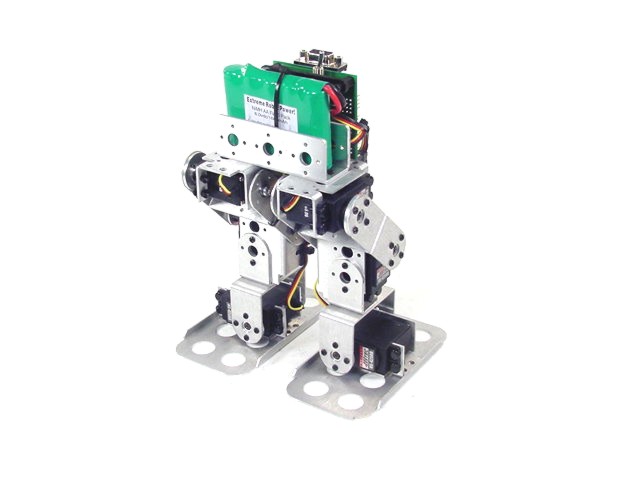
About the Lynxmotion Biped BRAT $286.00
BRAT stands for Bipedal Robotic Articulating Transport. The robot is a 6 servo biped walker featuring three degrees of freedom (DOF) per leg. The robot can walk forward or backwards and turn in place left or right with variable speed. It can even do lots of Robo-One style acrobatic moves. Our combo kits include everything needed to make an operational robot, however the chassis and servos are available separately for those who want to use their own electronics.

The Mechanics
The robot is made exclusively from brushed, or black anodized aluminum servo brackets from our Servo Erector Set. It also includes an electronics carrier made from ultra-tough laser-cut Lexan.

The Servos
We are providing the walker with Hitec HS-422 servos. Due to the robot's light weight, these servos work well.

Powering Options
As with any walking robot, weight is a major concern. The best approach is to keep the weight to an absolute minimum. We recommend using the 6.0 Volt Ni-MH 1600mAh Battery Pack (BAT-03) and the Universal Smart Charger (USC-01).

Controlling the Biped
The robot can be controlled in many ways. The combo kit for PC uses our SSC-32 and the Visual Sequencer to control the robots motion. It's a tethered configuration but can be made wireless with any commercial wireless serial device. We have example projects for the Visual Sequencer to get the robot going right away. We will offer a combo kit for Basic Atom as soon as we have programming available. We are working on wireless play station game controller code for remote control as well.

Important!
To keep costs down we are not providing printed Assembly Guides. They are provided online, so you will need to print them when you order the kits. By providing the Assembly Guides online we can provide more detailed and up to date information than the old hardcopy method allowed.


http://lynxmotion.com/Category.aspx?CategoryID=97


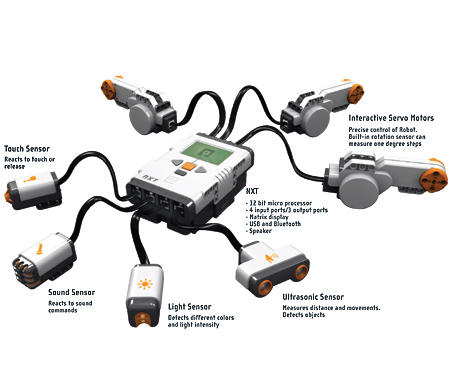
Lego NxT Robot Kit


$250.00


Bow to the next generation of LEGO Mindstorms – now, with a 32-bit processor, redesigned sensors, Bluetooth and more.

Features:

LEGO's newest robot-building kit, with greatly improved functionality
32-bit command center with large LCD, USB 2.0 and Bluetooth interfaces that allow robots to walk, talk and interact with their environment
Technic blocks ("studless legos") create a more human, less boxy look
Intuitive GUI and drag-and-drop icons are PC- and Mac-friendly
Redesigned touch and light sensors, new sound sensor and ultrasonic sensor
Now with three motors – redesigned for smoother, more reliable operation
6-wire digital cables for more precise connections
5 main themes (8 different models) – Vehicle: Roverbot, Animal, Scorpio; Machine: Robotic Arm; Human: Humanoid; Gadgets: Clock, Music, Game and Movers
Models are all built within the LEGO Technic System
Includes:
571 pieces
Quickstart Guide helps you build a robot ready for action within 30 minutes
Model-specific building instructions, tips and tricks, testing methods and programming options
Easy-to-use software
Test panel
The power of the LEGO building system, an intelligent command center and easy-to-use, drag and drop programming software unleash the power of your robot-building imagination.


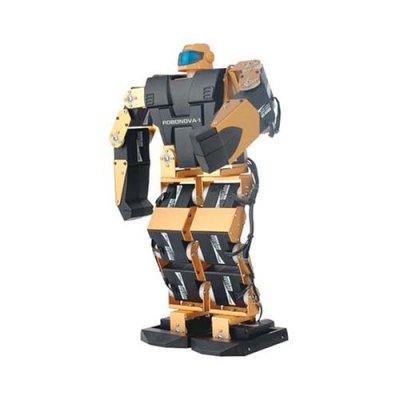
Robonova


Price: $999.99 & this item ships for FREE with Super Saver Shipping. Details


Availability: In Stock. Ships from and sold by Amazon.com.

Only 1 left in stock--order soon (more on the way).


2 used & new available from $999.99


‹ Return to Product Overview

--------------------------------------------------------------------------------

Product Features and Technical Details
Product Features
Advanced robot for students, hobbyists, and educators
Gold anodized metal servo brackets serve as strong and lightweight exoskeleton
Controlled with 16 powerful HSR-8498HB digital servos; includes IR controller
Micom control board can operate up to 24 servos and 16 accessory modules
Simple programming with supplied RoboScript and RoboBasic software
Technical Details


Model number: 77003
Height: 12.5 inches
Weight: 47 ounces
Micro controller board: MR-3024
Servos: 16
Battery: NiMH
PC connectivity: Serial port
IR controller: Yes
What's in the box: MR-3024 Micro controller board for 24 servos, 16 digital HSR-8498HB servos, re-chargeable NiMH battery and charger, RoboBasic programming software and manual, PC serial port programming interface cable, Remocon IR controller, assembly guide, user's manual


‹ Return to Product Overview


The three types of jobs robots do well are the dull, dirty, and dangerous


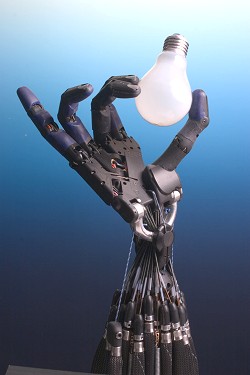
London-based Shadow Robotics - a group of inventors best known for their invention of a multi-use, 'dextrous' robotic hand, which can be used in a variety of domestic and industrial settings. The hand, which has 24 separately powered and controlled movements, has already caught the imagination of leading disability organisations and even NASA, which last year purchased one for €90,000


Each robot has to recognize objects on the field, know where it is in relation to other players, dribble the ball and follow a set of simplified, FIFA-based rules independent of outside influence. Ideally, they should also show some team spirit by cooperating with each other.


"Everything humans can do naturally has to be programmed in the robots," Mainz University's Peter Dauscher said of the machines, which can cost upwards of 3,000 euros ($3,851). "They need to be able to analyze the situation and decide what they should do."


Bildunterschrift: Großansicht des Bildes mit der Bildunterschrift: Not much competition for humans at the moment
Robocup organizers -- the sport has two international robot soccer federations, similar to world soccer governing body FIFA, as well as numerous national clubs -- have set an ambitious goal of fielding a team capable of beating a human World Cup team by 2050.

Saturday, November 25, 2006


But that is only the beginning. By 2015, the US Department of Defense plans that one third of its fighting strength will be composed of robots, part of a $127bn (£68bn) project known as Future Combat Systems (FCS), a transformation that is part of the largest technology project in American history.

The US army has already developed around 20 remotely controlled Unmanned Ground Systems that can be controlled by a laptop from around a mile away, and the US Navy and US Air Force are working on a similar number of systems with varying ranges. According to a US general quoted in the US Army's Joint Robotics Program Master Plan (http://tinyurl.com/yl7s52 - 13.8MB PDF), "what we're doing with unmanned ground and air vehicles is really bringing movies like Star Wars to reality". The US military has 2,500 uncrewed systems deployed in conflicts around the world. But is it Star Wars or I, Robot that the US is bringing to reality?


Japanese researchers have developed a flexible artificial skin that could give robots a humanlike sense of touch.
The team manufactured a type of "skin" capable of sensing pressure and another capable of sensing temperature.

These are supple enough to wrap around robot fingers and relatively cheap to make, the researchers have claimed.

The University of Tokyo team describe their work in the latest issue of the journal Proceedings of the National Academy of Sciences.

The materials they're using may not be completely novel but the integration appears to be something new

Douglas Weibel, Harvard University

The researchers explain how pressure-sensing and temperature-sensing networks can be laminated together, forming an artificial skin that can detect both properties simultaneously.

Takao Someya, lead author on the latest research, previously developed a form of artificial skin capable of sensing pressure.

But the ability to sense temperature as well allows the scientists to more closely imitate the functions of human skin.

Someya and his colleagues used electronic circuits as pressure sensors and semiconductors as temperature sensors. They embedded these sensors in a thin plastic film to create a net-like matrix.

Organic materials

The transistors used in the circuits and the semiconductors both use "organic" materials based on chains of carbon atoms.

This makes them mechanically flexible and relatively inexpensive to fabricate.

"Both of those characteristics sound compelling. The material sounds like it could have lots of functions," Dr Douglas Weibel, of the department of chemistry and chemical biology at Harvard University told the BBC News website.

"The materials they're using may not be completely novel but the integration appears to be something new."

The University of Tokyo scientists say their breakthrough has the potential to improve how robots will function in the real world.

And they add that there is no need to stop at simply imitating the functions of human skin.

"It will be possible in the near future to make an electronic skin that has functions that human skin lacks," the researchers write in Proceedings of the National Academy of Sciences.

Future artificial skins could incorporate sensors not only for pressure and temperature, but also for light, humidity, strain or sound, they add.

Friday, November 24, 2006


WASHINGTON (AP) -- David Hanson's robots can creep people out.

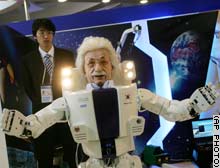
Their heads are so lifelike, their skin so textured and realistic, that Candy Sidner, a competing roboticist, called his Albert Einstein robot "spookily cool ... a giant step forward."

Hanson, who started his career as an artist and spent time working in Disney's Imagineering Lab, said he flirts with being too realistic for comfort. His work, he said, "poses an identity challenge to the human being."

"If you make it perfectly realistic, you trigger this body-snatcher fear in some people," he said. "Making realistic robots is going to polarize the market, if you will. You will have some people who love it and some people who will really be disturbed."

Hanson's robotics company in Dallas is the flip side of an industry focused on making robots more human on the inside. Hanson makes "conversational character robots." They are mostly human-looking heads using a skin-like material that he invented called Frubber. They are battery-powered, walk and are expressive, but from the neck down they don't look human at all.

The issue of being too human-looking is called "uncanny valley" syndrome, and Hanson embraces it with the passion and line-crossing of an avant-garde artist, which he also is.

Hanson made a robot head modeled on his own, but it wasn't for use as a robot. It was part of an art show where he made his self-portrait robot a "large homeless robot figure in a box." The idea was to go out of the "comfort zone" of science, he said.

But Hanson is also a businessman who is designing entertainment robots for the home. He hopes to have two-foot robots -- with human-looking heads that are more cartoonish than uncannily accurate -- that can dance, make eye contact, talk and recognize your face. The idea is to price them at $3,000 and get them on the market in about a year.

"It would be very much like Astro Boy in the old TV series," Hanson said.

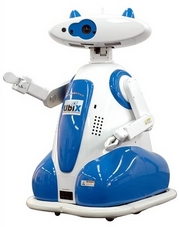
TOKYO - It can greet people, show DVDs and hand out balloons. "Ubiko," a robot-on-wheels with a catlike face, is joining the crew of temporary workers supplied by a Japanese job-referral company to stores, events and even weddings.

ADVERTISEMENT

Next month, the 44-inch tall robot will be selling mobile phones at a store, said Akiko Sakurai, a spokeswoman at the company, Ubiquitous Exchange.

Ubiko can be hired as a temporary worker for two hours for 105,000 yen, or $890.

"We see this as serious business. There are jobs that robots are better at," Sakurai said Wednesday. "People do develop an attachment with the robot, and it's lovable."

The $255,000 robot, which comes a camera and infared sensors, greets customers with a nasal electronic voice, shows DVDs with a projector in its head and hands out balloons and other goods with wireless remote-controllable arms, she said.

Ubiko is short for "ubiquitous computing" and "ubiquitous company" but also sounds like a Japanese female name, which often end with "ko."

Tmsuk, the Japanese manufacturer that makes the robot, sold three last month to a hospital, where they are working as full-time, rather than temporary, receptionists and guides, said company spokeswoman Rie Sudo.

One of the hospital's robots serves as a receptionist and has been programmed to greet visitors. It also has a touch-panel on its body, and visitors can use it to get directions for where they want to go.

Thursday, November 23, 2006

Cat Travis (mail) (www):
Our exit from Iraq will be shameful at best. There will be no dignity in it what so ever. For that reason we will be stuck there. We will be unable to admit defeat. Hopefully this will be useful the next time we think about invading another country. Korea, Vietnam and now Iraq, how long will it be before we do it again? Can we ever learn our lesson? Will this be our legacy? What makes us this way? Is it just the nature of the human race? We keep crowing about being some kind of different. Are we any worse or any better than anyone else? We sure do love ourselves. Our nationalism keeps leading us astray just as it did Germany.
11.23.2006 5:28am

http://www.themoderatevoice.com/posts/1164241586.comments.shtml
"If society fits you comfortably enough, you call it freedom." : Robert Frost

Wednesday, November 22, 2006


Project participants: Josh Bongard, Victor Zykov, and Hod Lipson (see team picture). Please mention all team members when covering this work. Thank you.
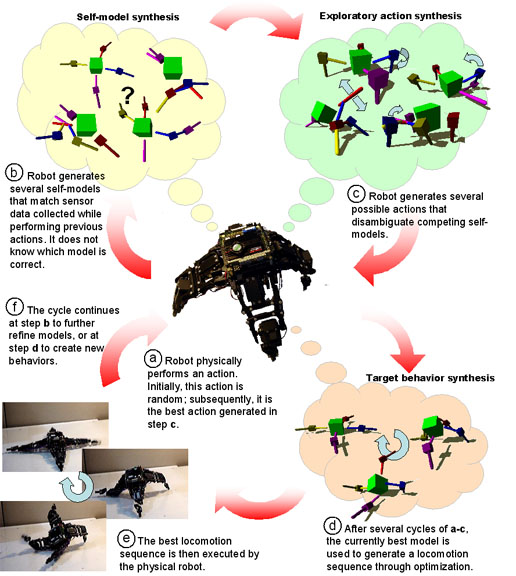
Higher animals use some form of an "internal model" of themselves for planning complex actions and predicting their consequence, but it is not clear if and how these self-models are acquired or what form they take. Analogously, most practical robotic systems use internal mathematical models, but these are laboriously constructed by engineers. While simple yet robust behaviors can be achieved without a model at all, here we show how low-level sensation and actuation synergies can give rise to an internal predictive self-model, which in turn can be used to develop new behaviors. We demonstrate, both computationally and experimentally, how a legged robot automatically synthesizes a predictive model of its own topology (where and how its body parts are connected) through limited yet self-directed interaction with its environment, and then uses this model to synthesize successful new locomotive behavior before and after damage. The legged robot learned how to move forward based on only 16 brief self-directed interactions with its environment. These interactions were unrelated to the task of locomotion, driven only by the objective of disambiguating competing internal models. These findings may help develop more robust robotics, as well as shed light on the relation between curiosity and cognition in animals and humans: Creating models through exploration, and using them to create new behaviors through introspection. Watch a movie here.

Tuesday, November 21, 2006

http://www.themoderatevoice.com/posts/1164079994.shtml
Cat Travis (mail) (www):
I too have a problem with anger. It's been diagnosed as borderline personality disorder. It has plagued me since I was a young child. Nothing gives me a bigger thrill than to be uncivil. I just love to go to extremes. It gives me a kind of euphoria. Revenge can feel better than love to some. It's a sick sad existence. I've been in therapy since 1969. I now live in a self imposed solitude. People say behavior can be modified if the desire is there. I feel I am evidence to the contrary. Am I evil? What am I? Of course there is tourette syndrome where the person absolutely has no control. There are so many things out there than can ruin your life. For those of you that are normal be very, very grateful.
11.21.2006 10:49am

Saturday, November 18, 2006


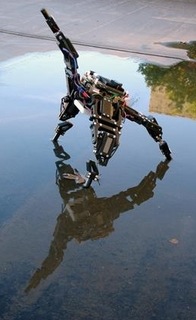
Oh great. As if the potent, robotic cocktail of self-replication, self-awareness, and wireless power weren't bad enough, along comes Cornell University with a robot capable of not only discovering its own nature (something we can't even do) but then adapts to overcome injury. This four-legged robot starts out knowing only what parts it has, not where they are or how to use them for locomotion. It applies a scientific method of theory and experimentation to develop computer models and ultimately, a set of commands to turn its motors for that first cautious step. Even when researchers remove part of the toddling robot's leg, the little guy still figures out a way to limp forward. Cornell scientists go so far as to say that the robot is "conscious," albeit on a primitive level since it thinks to itself, "what would happen if I do this?" Yeah, that's a stretch, but a step closer to our doom nevertheless. Although the robot used to demonstrate these cognitive gymnastics is quite simple, the algorithm could be used to build more complex robots for say, space exploration or defending itself while standing in line for a PS3. Well, at least The Robots don't currently have a place to coalesce under a common roof of intellectual ferment... oh God, no! Still, any robot which drinks puddle water can't be too bright, eh?

Wednesday, November 15, 2006

Dear Diane Hall:

I have BPD, manic depression and attention deficit. I have come across many other people with the same diagnosis. I feel like I only have one thing. It is just the way the DSM is written that makes it into three different illnesses. I live a life of self imposed solitary confinement. I know that anything that I grow to love I'll grow to hate. It is just simpler to avoid it in the first place. This is the most normal that I can be. I once saw attention deficit explained as the search for stimulation. I see manic depression in much the same way. I have seen epilepsy explained as the brain's need for chaos. Both manic depression and epilepsy share a phenomena called kindling. I feel that what I have is a somewhat watered down form of epilepsy. Thank you for letting me share these opinions with you. Sincerely,
Cat

Robot Radiosurgery Firm Files for IPO
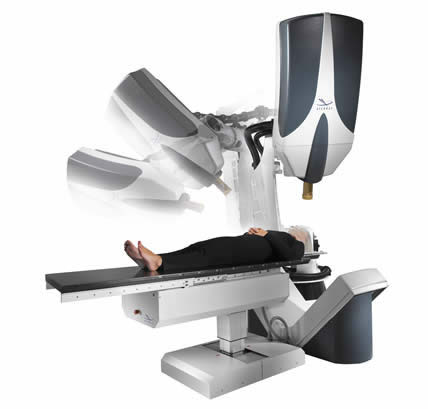
Accuray, the makers of the robot radiosurgery machine CyberKnife have applied with the SEC for a stock offering.The Sunnyvale, California company was founded in 1990 to sell the first Cyberknife systems for limited use radiosurgery in treating tumors in the head and neck.Since then, the robot system has advanced and successfully used for many different radiosurgery procedures.Over 140 of the multi-million dollar machines have been installed worldwide.Accuray will try to raise US $230 million in the offering.Making Radiosurgery an Option for Every Cancer Patient
posted by Prospector at 1:25 PM

Thursday, October 19, 2006


Technology Review: Shape-Shifting Rovers: "An early prototype of the tetrahedral robot (above) was tested at Meteor Crater, in Arizona. A larger, more advanced device made up of 12 tetrahedrons is now going through its final assembly in the lab."

Thursday, October 05, 2006

The Reaction -- by Michael J.W. Stickings: Why W is such a nightmare: "during his campaign for the GOP nomination in 2000, Keyes said something like, 'All I'm asking people to do is to take a look at George W. Bush, listen to him speak. And I ask you, Does this seem like someone who has ever had to make a serious moral decision in his life? Does this seem like someone who has ever had to take a real stand, to really sacrifice something, to make a genuinely difficult decision? And if he hasn't yet, why would he start now? And is this really the situation to trust that he will?'"
The Moderate Voice - Americans' Love Affair With The Gun: "I can understand the feelings/emotional attachment of those who own guns. But I also feel that an owner of the gun must have certain family/clan/society traditions/values to uphold. A tremendous self-discipline and training is required by those who possess guns...otherwise the gun becomes a mere tool to commit violence."

Saturday, September 02, 2006

Yahoo! News Message Boards Politics News: "I DO utterly hate and despise George W. Bush, Dick Cheney, and Donald Rumsfeld. It is right to hate and despise people who dragged our nation into an unnecessary and unwinnable war, who break the laws and fail yo uphold the United States Constitution, and subvert everything good our flag stands for--the rule of law, republican government, and freedom from fear. They ate hateful and despicable.

Perhaps it is wrong for a Christian, to hate, but this does not mean the Bush regime has not EARNED a modicum of hatred. No administration in U.S. history has been so deserving of the loathing and detestation of the American people"

Thursday, August 31, 2006


Untitled Document: "ARMAR Humanoid Robot For The Kitchhen - Okay, Roomba and Scooba are doing the floors. Now, what about the dishes? That is up to ARMAR, the kitchen bot."

Tuesday, August 29, 2006

AT&T - Checkout - Order Confirmation - RESIDENTIAL - MO: "Order Confirmation


Your order is complete.

Thank you for renewing your service, and we hope you continue to enjoy your AT&T Yahoo! High Speed Internet experience.

A copy of your order will be emailed to the contact email address you provided.

If you have any questions about your order, please contact us at 1-877-722-3755.
Order Number: RWP0029142XDW


Summary of Charges for: 6602482751
ItemsQuantityMonthly Price*One Time Charge*Payment Method
AT&T Yahoo! High Speed Internet Pro Package Terms and Conditions
1$17.99Bill My Account


Charges for 6602482751 :
$17.99"

Saturday, August 26, 2006

ScienceDaily: 'Termite Guts Can Save The Planet,' Says Nobel Laureate: "Chu, who shared the Nobel Prize for Physics in 1997, has begun studying termite guts -- one place in nature where a key hurdle for carbon-neutral energy supply has already been solved. Termite guts take indigestible cellulose, which makes up the bulk of all plant material grown on earth, and convert it to ethanol, which even today is a versatile and popular fuel. "

Thursday, August 24, 2006

Trossen Robotics - Robot Kits - Robot Parts - Robot Sensors - Robot controllers: "It's not a hard concept to grasp. A new model in robotic development. One which allows for students, hobbyists, and research labs to share their code and advancements with each other. For far too long robotics have been reinventing the robotic wheel over and over and over again. It's time we start standing upon each other's shoulders and advancing together as a worldwide community. "

Wednesday, August 23, 2006

robots.net - Robot news and Robotics Info: "Forget about playing checkers or chess with a robot. Yukiyasu Kamitani and other Researchers at ATR Computational Neuroscience Labs have developed a system that does rock paper scissors by reading your mind. How does it work? You'll need to be inside an MRI scanner. A computer decodes the MRI output to identify the 'perceptual and subjective contents' of your brain. As you make rock, paper or scissors hand gestures, your brain configuration is used to control a robot hand that duplicates your movements. Obviously, the real goal here is to develop non-invasive methods of controlling prosthetic devices. So far the researchers have achieved 85% accuracy with a 7 second lag time on the current setup. The good part is that it works on anyone without surgery or special training. The bad part is that you need a massive MRI machine"

Friday, August 18, 2006

Robot Gossip: Robot Works on AIDS Vaccine: "A new lab robot called CrystalMation promises to speed up the discovery of new vaccines for HIV and other diseases.
The robot was developed by the RoboDesign division of privately held Rigaku.

Located at Scripps Research Institute, the $2.2 million Crystalmation, can complete in days a task that had previously taken months to perform."
ScienceDaily: Brain's Cannabinoid System 'Mellows' Seizures: "The same brain machinery that responds to the active substance in marijuana provides a central 'on-demand' protection against seizures, researchers have found. They said their discoveries suggest that the 'endocannabinoid' system might constitute a prime target for drugs against seizures of epilepsy and other neurodegenerative diseases"
Beyond the Event Horizon: "Why spend billions of dollars and numerous years to cure just cancer? Why not spend that time on something that will not only cure cancer, but will also cure every other disease, including aging, and death? And what if that same development also ended poverty and starvation? I think the humanitarian value of that development would far exceed any other."

Saturday, August 12, 2006

Motion Capture Hardware - Gloves: "CyberGlove� is a low-profile, lightweight glove with flexible sensors which accurately and repeatably measure the position and movement of the fingers and wrist. CyberGlove's award-winning design incorporates the latest high-precision joint-sensing technology. CyberGlove is state-of-the-art in instrumented gloves.
The 18-sensor model features two bend sensors on each finger, four abduction sensors, plus sensors measuring thumb crossover, palm arch, wrist flexion and wrist abduction.
The 22-sensor model adds sensors to measure the flexion of the distal joints on the four fingers."
InformationWeek Gartner Gartner Names Hot Technologies With Greatest Potential Impact August 9, 2006: "Researcher Gartner Inc. on Wednesday identified the technologies it believes will have the greatest impact on businesses over the next 10 years, naming such hot areas as social-network analysis, collective intelligence, location-aware applications and event-driven architectures. "

Sunday, August 06, 2006

KurzweilAI.net: "For the first time, scientists have been able to watch neurons within the brain of a living animal change in response to experience. "

Thursday, August 03, 2006

KurzweilAI.net: "Reason is rooted in desire. Reason evolved in order to increase our ability to satisfy our emotional states.

At the heart of every logical and well reasoned human action / thought is an emotion. "
Amazon.com: Reviews for Tuscan Whole Milk, 1 Gallon, 128 fl oz: Gourmet Food: "Resurrection by Milk, August 3, 2006
Reviewer:D. S. Baker (Manassas, VA USA) - See all my reviews

I had recently 'acquired' the milk through dealings with a less than ligitimate source, but the claims were true. This milk has resurrected the dead, my interest in college football, and David Hasselhoff's career; all with only one gallon!"

Saturday, July 29, 2006

Robot-Assisted Prostate Surgery: "Robot-Assisted Prostate Surgery
IN THIS SECTION
da Vinci Surgical System
Frequently Asked Questions
Prostate Cancer

If your doctor recommends surgery to treat your prostate cancer, you may be a candidate for the da Vinci Prostatectomy, a new, less-invasive approach to prostate removal. This method incorporates the latest advancements in robot-assisted technology that allows surgeons to perform complex surgeries with greater visualization and precision while speeding patient recovery."

Thursday, July 27, 2006

Our Technological Future: Are You Immune to Cancer?: "Seven years ago, biochemist Zheng Cui of Wake Forest University was conducting a routine experiment, injecting test mice with a strain of cancer cells so aggressive it caused a 100 percent death rate. Oddly, one of the mice wouldn't die. Thinking he had made an error, Cui injected the mouse with a million times the lethal dose, but it still lived.

Cui was intrigued. He bred the mouse and found that 40 percent of its offspring share a remarkable resistance to many forms of cancer. When the animals' immune systems identify a cancer cell, a genetic tweak allows their bodies to launch a massive attack of white blood cells that kills the budding tumor.

Now Cui and his colleagues have found a clue that may point the way to an actual cure. When they inject white blood cells from any of these anticancer mice into their nonresistant brethren, the injected animals become resistant as well, fighting off induced cancer in a matter of weeks or avoiding it entirely.

Even more promising, Cui has sampled a group of human volunteers and found that 10 to 15 percent have similar super cancer-fighting white blood cells. That could explain why some people never get cancer and why others' tumors spontaneously regress. Cui proposes injecting these people's white blood cells into cancer patients to see if he can transfer their immunity."

Sunday, July 23, 2006

WorldFitness.CA - News - Men Who Sleep With A Partner Are Dumber: "In a new study, researchers found that when men slept with a partner, their sleep was disturbed enough to cause a decline in cognitive ability the next day


Austrian scenists warn that men who sleep with their wives are at risk of damaging their brains - at least in the short term"

Friday, July 21, 2006

People's Daily Online -- First robot restaurant opens in HK: "A robot waiter (L) serves in the first Robot Restaurant in Hongkong opened on July 17,2006. Robots serve as waiters to take orders and give performances in this restaurant.


Guests pose for a photo with a robot waiter in the first Robot Restaurant in Hongkong opened on July 17, 2006. Robots serve as waiters to take orders and give performances in this restaurant."
People's Daily Online -- First robot restaurant opens in HK: "A robot waiter (L) serves in the first Robot Restaurant in Hongkong opened on July 17,2006. Robots serve as waiters to take orders and give performances in this restaurant.


Guests pose for a photo with a robot waiter in the first Robot Restaurant in Hongkong opened on July 17, 2006. Robots serve as waiters to take orders and give performances in this restaurant."

Monday, July 17, 2006

Robot Gossip: Dyson's Robot Vacuum Cleaner: "well known for their high priced bright yellow vacuum cleaners will be offering their version of the home robot later this year.
The US $6000(Yen 684,000)Dyson DC06 will break new ground in the field of home appliances that are more intelligent than their owners.

According to Gizmag, along with the breakthrough pricing you get a vacuum that is:

Capable of 'learning' the layout of a room without and navigating safely around unforseen obstacles, the DC06 is 5% vacuum cleaner and 95% robotic intelligence. Combining over 70 sensory devices and three on-board computers with independent wheel, microprocessor-driven SR electrical motors, the DC06 can make 10 decisions every second, enabling it to manoeuvre precisely and clean efficiently without repetition, even recognising when the job is done."

Tuesday, May 02, 2006

Most E-Mailed New York Times Articles in the Past 24 Hours - The New York Times: "Prices have increased 900%, with toilet paper costing $417 per sheet at one supermarket."

About Me

My photo
eureka, California, United States
As Popeye once said,"I ams what I am." But then again maybe I'm not